
Specification
Specifying a multihead weigher for low target weights
Low target weight is not a complete specification. Learn what actually determines whether multihead weighing suits your product — piece weight, feeding, bucket configuration and more.
01 / Weighing principles
Why a gram figure alone doesn't specify the machine
A low target weight is often the first thing a buyer mentions when enquiring about a multihead weigher — and it's one of the least useful figures on its own. Two products with an identical 20 g target can demand completely different machine configurations, depending on how many individual pieces make up that 20 g, how much those pieces vary in weight, how the product flows, and how it needs to be discharged into the pack below.
Specifying the right equipment means looking past the target weight to the physical behaviour underneath it. This article sets out what actually needs to be established before a multihead weigher — or any weighing method — can be recommended with confidence.
How a multihead weigher builds a target dose
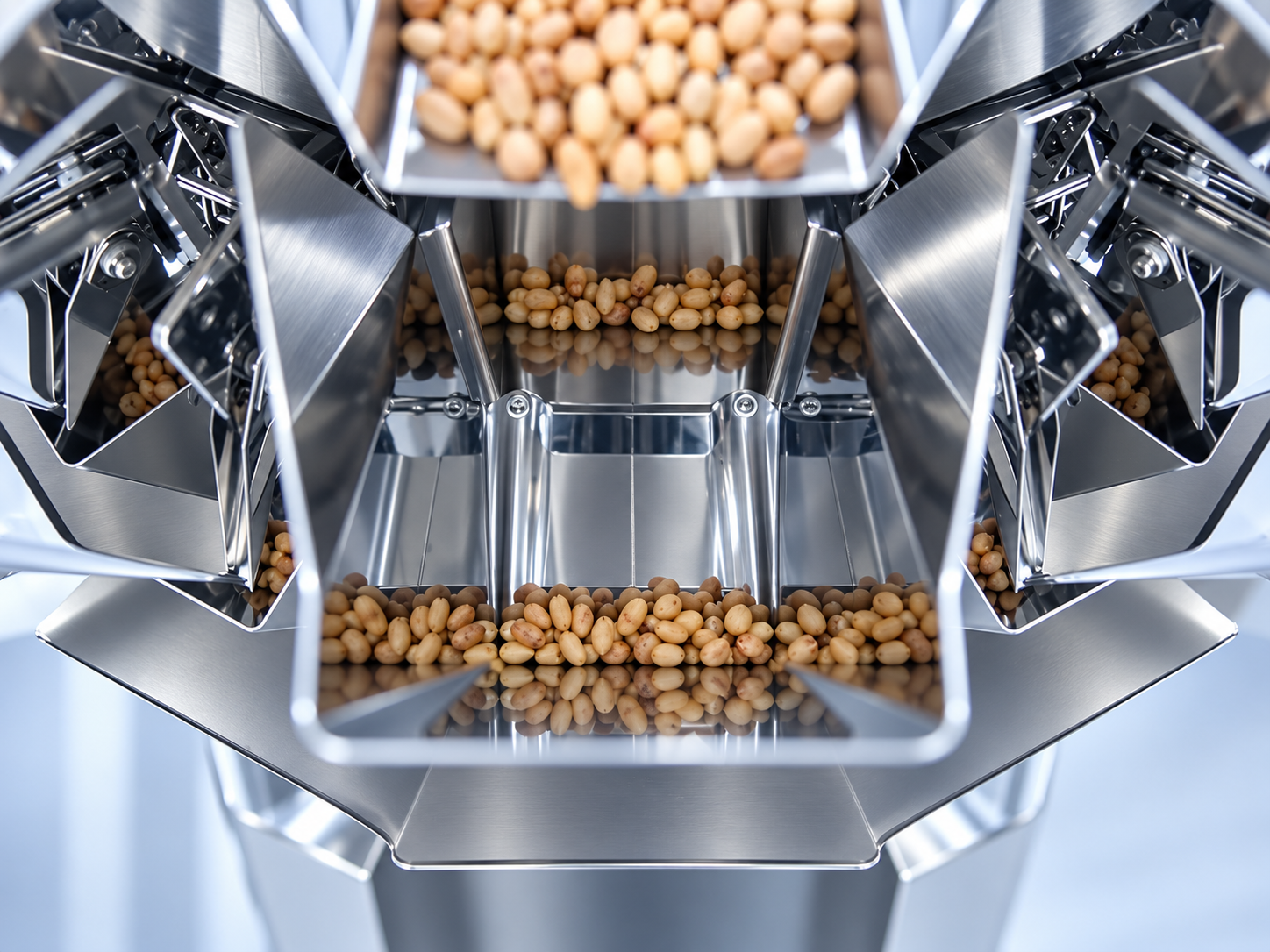
A multihead weigher distributes incoming product across a ring of independent weighing heads. Each head holds and weighs a small portion of product on its own load cell. A control system then tests combinations of those individual head weights and selects whichever combination comes closest to the target — conventionally at or above the set weight, depending on the control strategy and application — before releasing only that combination into the pack below. The remaining heads refill and the cycle continues.
Additional weighing heads can increase the pool of combinations available to the control system. Whether that produces a useful performance advantage depends on the product, feed distribution, usable hopper weights, target range and control strategy together — not on head count in isolation. Head count is one configuration variable among several, and it's selected for the actual application rather than assumed from the target weight alone.
Individual head weights
Combinations assessed
Selected heads discharge
Piece weight matters as much as pack weight
The single most overlooked factor in low-weight specification is the weight of the individual pieces making up the pack — and how much that weight varies from piece to piece.
Consider a nominal 20 g target, used here purely to illustrate the principle rather than as a machine specification. If the product is a fine, uniform granule where each piece weighs a small fraction of a gram, the machine has considerable flexibility to combine pieces into a dose that sits close to target. If instead each piece weighs two or three grams, the machine may be selecting between a much smaller set of possible combinations to reach the same 20 g — and if piece weight varies significantly between individual pieces, that range of achievable combinations narrows further still. The pack target hasn't changed, but what's achievable around it has.
This is why "low target weight" is not itself a complete brief. The real questions are: how many individual pieces typically make up one pack at this target, and how consistent is the weight of those pieces? Product description, photographs, and — where available — data on individual piece-weight distribution answer this far more usefully than the target weight alone.
02 / Feed & configuration
Product behaviour and feeding
A weighing machine can only perform as well as the product presented to it. Multihead weighers depend on a steady, evenly distributed flow of product across the weighing heads — feeding too little limits the combinations available to the control system, while feeding too much can overload the pans and disrupt accurate weighing. Getting this balance right is as much a part of specification as the weigher itself.
Different products can need different feeding approaches. Vibratory feeding can suit many free-flowing, dry products well. Sticky, soft, or otherwise difficult-to-convey products may not move reliably under vibration alone, and specialist screw-fed multihead configurations exist for applications where vibration doesn't move the product as needed. Fragile products raise a related but separate concern: excessive vibration or drop height can damage delicate pieces before they reach the pack.
None of this is specific to low target weights, but it becomes more consequential at low weights, because there's less margin in each individual dose to absorb an uneven feed.
Why bucket size and machine configuration matter
A weighing hopper sized for a moderate portion doesn't necessarily suit a very small one. Product presentation within an oversized bucket, minimum practical feed quantities, and discharge behaviour can all become less predictable when the portion being handled is small relative to the bucket it sits in.
This is part of why specialist multihead configurations exist in the market — compact, low-weight machine variants built with different weighing resolution and bucket geometry specifically for small portions of high-value, low-weight products such as herbs, spices, tea and small confectionery. Their existence is useful evidence in itself: a standard, general-purpose multihead configuration is not automatically the right tool simply because a target weight happens to be low. Matching bucket geometry, feed method, and weighing resolution to the actual product is part of what determines suitability — and that matching happens during specification, not by assumption.
Heads and combination availability
As covered above, head count is one factor in how many combinations a multihead weigher's control system has to draw on — not the only one, and not a number that can be set from the target weight alone.
Additional heads can increase the pool of available combinations, but whether that translates into a meaningful advantage for a given application depends on the product, the feed, the usable hopper weights, and the target range together. The right configuration is the one matched to the specific product, target range and output requirement, established during specification rather than assumed in advance.
03 / Production requirements
Accuracy, tolerance and giveaway
These three ideas are often used loosely, but they mean different things and a buyer should be clear on all three before specifying equipment:
A weighing system doesn't eliminate these trade-offs; it manages them. Getting a genuinely useful specification means defining the acceptable pack-weight range and the commercial giveaway objective up front, alongside any finished-pack weight verification requirements — rather than treating "accurate" as a single fixed figure that applies to every product and market.
- Target weight is the nominal fill you're aiming for.
- Tolerance is the acceptable range around that target, based on the product and commercial/quality requirements. Applicable metrology requirements may also need to be considered depending on the product and destination market.
- Giveaway is the average amount given away above the label weight to stay within tolerance, which has a direct commercial cost over volume.
Sustained output and downstream packaging
A quoted maximum machine speed is not the same as the achievable rate for a specific product, and it's rarely the same as the sustained output across a full production run once feeding, discharge timing, and downstream equipment are factored in. Low target weight has no automatic relationship with higher speed — output depends on the product, the feed system, and the packaging equipment the weigher is feeding into.
The weigher doesn't operate in isolation. Discharge opening size, drop height, transfer chutes, and product settling time all interact with whatever sits below the weigher — a VFFS bagger, a premade pouch machine, or another fill point — and narrow pack formats or fragile products can constrain how that discharge needs to be handled. A completed line is a system, and the weigher's contribution to output can only really be assessed alongside everything downstream of it.
Weight versus count
Weight and count are not the same production objective, and it's worth being explicit about the difference before specifying equipment. A brief of "10 pieces per pack" is not automatically the same as "10 g per pack" — where individual pieces vary in weight, hitting one target doesn't guarantee hitting the other. If the real production requirement is a specific piece count rather than a specific weight, that should be established clearly at the outset, since it can point toward a different specification path entirely.
04 / Choosing a method
A word on powders
It's worth addressing directly, because it's a common point of confusion: a low target weight doesn't automatically point toward multihead weighing, and this is especially true for powders. Powder is a physical form, not a single packaging behaviour. Fine, cohesive or poorly flowing powders may be better suited to controlled auger dosing than to weighing, regardless of how small the target weight is. Some free-flowing or agglomerated materials may be weighable; others won't be. The material's actual flow behaviour — not its target weight — determines the right dosing method.
Multihead versus linear weighing — a genuine comparison
Multihead and linear weighing are parallel engineering options, not a hierarchy. Which one suits a given application depends on the interaction of several factors: output requirement, target-weight range, product behaviour, the level of giveaway control needed, number of SKUs and changeover frequency, cleaning and footprint constraints, and how the line needs to integrate with equipment upstream and downstream.
A linear weigher can be entirely appropriate where product behaviour suits it, output requirements match, and operating simplicity is valuable — it is not a lesser or more basic option simply because it's a simpler one. A multihead weigher becomes particularly valuable where the combination-weighing method offers a genuine advantage for the specific product, target weight, and giveaway objective in question. If a simpler machine solves the actual problem in front of you, that's a legitimate recommendation, not a compromise.
05 / Before you specify
What to establish before specifying
A useful specification for a low target weight application typically depends on:
Detailed product information, photographs, video and production data are the preferred starting point for establishing suitability. If physical assessment is needed, Libratus will advise on the appropriate route during specification.
- A clear product description, with photographs or video where possible
- Individual piece dimensions and, where relevant, piece-weight distribution
- Bulk density and general flow behaviour
- The actual target weight and acceptable pack-weight range
- Required sustained output, not just headline speed
- Pack format and downstream packaging equipment
- Any known handling sensitivities — fragility, stickiness, static, dust
How Libratus approaches low-weight applications
Libratus treats low target weight as the start of a specification conversation, not the end of one. Rather than assuming a multihead weigher — or any single method — is the answer because a target happens to be small, the actual product, feeding behaviour, tolerance requirements and downstream line are worked through to determine which approach genuinely fits.
Your product, your application
Get in touch
If you're weighing up a low target weight application and want a considered view on the right method, get in touch with Libratus to talk through your product and production requirements.
Discuss your project