
Machinery safety
AS/NZS 4024 guarding considerations for VFFS lines
A practical guide to AS/NZS 4024 and VFFS machinery guarding in Australia and New Zealand — hazards, guard types, interlocking and what to ask before specifying a line.
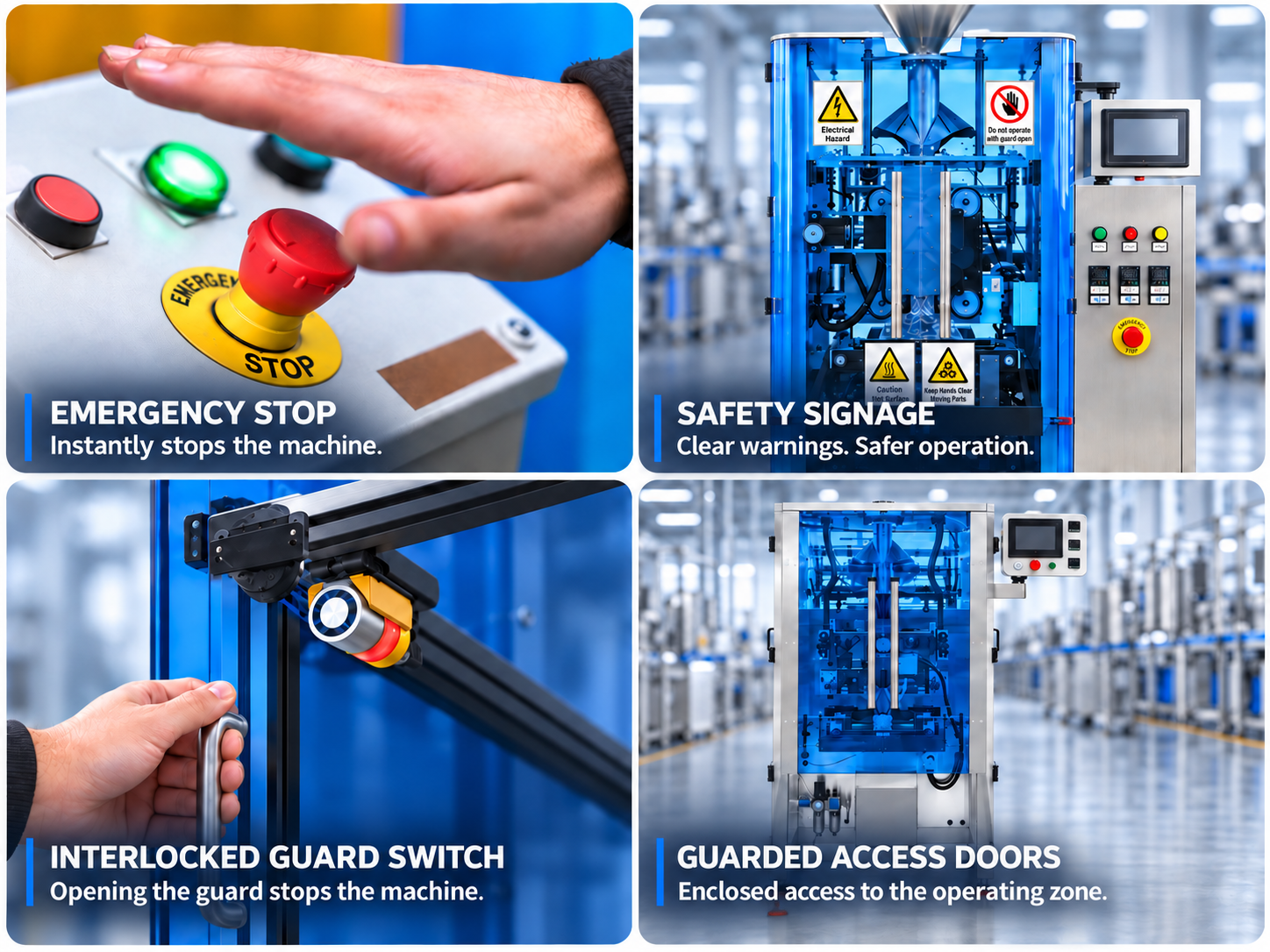
01 / Standards & hazards
Why VFFS guarding is more than enclosing the machine
It's tempting to treat guarding as a finishing step — a metal panel around the moving parts, a door switch, an emergency stop button, and a CE mark on the machine's rating plate. On a vertical form-fill-seal (VFFS) line, that view misses most of the actual safety question.
VFFS machines can combine several distinct hazard types in a small footprint: mechanical pinch and crush points in the sealing jaws, entanglement risk in film handling and pull mechanisms, thermal risk from heated sealing surfaces, and — once the bagger is connected to an upstream multihead weigher or linear weigher and downstream conveying or checkweighing — a set of interface considerations that don't exist when any single machine is assessed on its own.
Guarding a VFFS line properly means addressing all of that, not just enclosing the visible moving parts.
What AS/NZS 4024 does — and does not — mean
AS/NZS 4024 (Safety of Machinery) is an important machinery-safety reference across Australia and New Zealand, although its precise role differs by jurisdiction.
Safe Work Australia material identifies the AS 4024 Safety of machinery series among relevant standards for machinery and machinery guarding. WorkSafe New Zealand gives the series particularly strong weight, describing it as representing the current state of knowledge for safeguarding machinery and plant.
Both countries place machinery-safety duties on relevant parties across the machinery lifecycle, but the exact statutory duties, terminology and responsibilities depend on the jurisdiction and the role of the party involved.
Standards such as AS/NZS 4024 provide recognised technical guidance and reference points for that work, but following a standard does not automatically resolve every statutory duty.
For a technical buyer, the practical takeaway is straightforward: AS/NZS 4024 is an important reference to discuss with a supplier, but “we have a CE mark” or “there's an interlock on the door” is not the same as demonstrating that the actual machine and installation have been properly considered.
Typical VFFS danger areas
VFFS machines vary between manufacturers and configurations, but functional hazard areas can include:
- Film handling — the unwind reel, tensioning/dancer assembly and film rollers, which can present entanglement and nip hazards.
- The forming area, where film is folded around the product tube and which may require access for threading and adjustment.
- Vertical sealing jaws, which may combine mechanical movement with heated surfaces.
- Horizontal/cross-sealing and cutting systems, which can combine motion, heat and cutting or perforating elements depending on configuration.
- Pull/draw mechanisms advancing film through the machine.
- The product transfer point where product enters from the weigher or filler above.
- The discharge conveyor, where nip points may exist depending on the arrangement.
02 / Guards & access
Fixed guards, movable guards and interlocking
Guarding decisions generally follow the access pattern of the hazard rather than one fixed rule.
Fixed guards may suit areas that do not require routine access. Movable guards may be appropriate where routine access is genuinely needed, such as a film-change or jam-clearing access point, and depending on the risk and stopping behaviour involved, interlocking or guard locking may be appropriate.
Not every movable guard requires the same interlock arrangement. The appropriate approach depends on the hazard behind it.
It is also important to distinguish between a guard opening and a hazard actually being rendered safe. What matters is whether hazardous conditions — including motion, heat or stored energy — have been addressed by the time access is possible.
Openings, access and safety distance
VFFS lines typically require genuine production openings, including the product transfer point from the weigher or filler above and the exit for finished packs.
The fact that an opening is needed for production does not, by itself, establish that it is safe from an access perspective.
The relevant question is whether the geometry allows a person to reach a hazard before that hazard has been rendered safe. That depends on the actual dimensions and configuration of the machine and guarding and should be established during specification rather than from a generic rule of thumb.
03 / Safe intervention
Emergency stops are not a substitute for guarding
An emergency stop does not resolve the guarding question.
It is a supplementary protective measure, not a substitute for safe design, appropriate guarding or other protective measures.
It also does not automatically remove every form of stored energy or residual hazard.
Guarding and risk reduction therefore need to be considered independently of whether an emergency-stop device is present.
Unexpected start-up and residual hazards
Closing a guard, resetting an interlock or restoring power should not, by itself, create unexpected hazardous movement.
This matters particularly during activities such as film threading, jam clearing and cleaning, when someone may be close to the mechanism.
Stopping motion is also not the same as eliminating every hazard. Residual hazards can remain because of:
- heat
- pneumatic energy
- gravity
- stored mechanical energy
- residual movement
Cleaning, film change and jam clearing
A machine can be well guarded during normal automatic running and still create unnecessary risk if foreseeable routine activities require operators to defeat guarding or reach into danger areas. For VFFS equipment, those activities can include:
- cleaning sealing components
- clearing film or product jams
- changing film reels
- threading film
- routine adjustment
Thermal hazards around sealing systems
Heat needs to be considered separately from mechanical movement.
A sealing component may remain hot after motion has stopped, including behind an interlocked guard.
An interlock that stops movement does not automatically remove thermal risk.
This illustrates the broader point that one protective measure may address one hazard without addressing every other hazard associated with the same mechanism.
04 / Lines & imported machinery
The weigher, filler and bagger as one integrated line
A VFFS bagger commonly works as part of a wider packaging line.
It may receive product from a multihead weigher, linear weigher or auger filler and discharge into conveying, checkweighing, coding or other downstream equipment.
Integration can introduce considerations that do not exist when individual machines are considered separately, including:
- new access points at machine interfaces
- combined stop and restart behaviour
- control-system interactions
- guarding interfaces
- changes to how routine access occurs
Imported machinery and overseas conformity evidence
Buyers of imported VFFS machinery commonly encounter CE marking and manufacturer conformity documentation.
CE relates to the applicable European conformity framework. It may provide useful supporting evidence about the machine's design and conformity process, but it does not automatically establish that the actual Australian or New Zealand installation satisfies local machinery-safety requirements.
Australian and New Zealand frameworks place machinery-safety responsibilities on relevant parties within the supply chain. The exact duties depend on jurisdiction and role, so overseas paperwork should be treated as part of the evidence considered during specification rather than as a substitute for assessing destination-market requirements.
05 / Before you order
What buyers should ask before ordering
A practical set of questions to work through with a VFFS supplier before specification is finalised includes:
- What hazards were identified and considered in the guarding design?
- Which guards are fixed, and which are movable or interlocked — and why?
- What happens when an interlocked guard is opened?
- Does hazardous motion stop before access becomes possible where required?
- Are residual thermal or stored-energy hazards present, and how are they addressed?
- How are routine jam clearing, film change and cleaning accommodated without defeating guarding?
- What changes when the machine is integrated with the upstream weigher/filler and downstream equipment?
- Who is responsible for the relevant line-level guarding, integration and commissioning activities for this project?
- What documentation and drawings will be supplied for the installation being ordered?
How Libratus approaches guarding and integration
For Australian and New Zealand projects, relevant machinery-safety requirements and standards are considered during specification, including AS/NZS 4024 where applicable.
The documentation supplied is confirmed during specification and depends on the selected machine, destination market, installation/use and customer requirements.
For integrated VFFS projects, Libratus considers guarding and access in the context of the complete line during specification rather than treating the bagger as an isolated decision.
If physical assessment is needed, Libratus will advise on the appropriate route during specification.
Your product, your application
Get in touch
If you're specifying a VFFS line for Australia or New Zealand and want to discuss guarding, integration and the machinery-safety considerations relevant to the installation, contact Libratus to discuss the project.
Discuss your project