
Produce weighing ·
What does overfilling produce bags cost a packhouse?
Eight extra grams in a 500 g bag are hard to spot on a packing bench. Across 2,000 bags a day and 250 packing days, those eight grams add up to four tonnes of produce. Before pricing a new packhouse weigher, find out how much of that giveaway a change to your line could actually recover.
Start with one product and one pack size
Record consecutive finished pack weights during a normal run. Subtract the packaging weight to get the net produce weight. Keep the size grade, target weight and bags per hour alongside the readings. Set aside rejects and rework in the record so that only saleable bags enter the cost estimate.
For example, if saleable 500 g bags average 508 g net, the average excess is 8 g per bag. Keep the individual readings too. An average can hide occasional light bags. Have your quality team check that any proposed change still meets your pack requirements.
Why are my 500 g bags of baby potatoes coming out heavy?
Imagine your packhouse is filling 500 g bags of baby potatoes. Watch the last two potatoes on the vibrating tray. If one would bring the portion up to weight but both roll off together, the second adds giveaway. Both are already in flight before the weigh hopper, the bucket that weighs the portion, registers either one.
With a steady trickle of granules, some weighers stop the feed a little early to allow for the weight still falling. With whole potatoes, the extra weight depends on which pieces leave the tray together. That makes the last few centimetres of the feed path worth watching.
How a three-stage linear weigher feeds the last few pieces
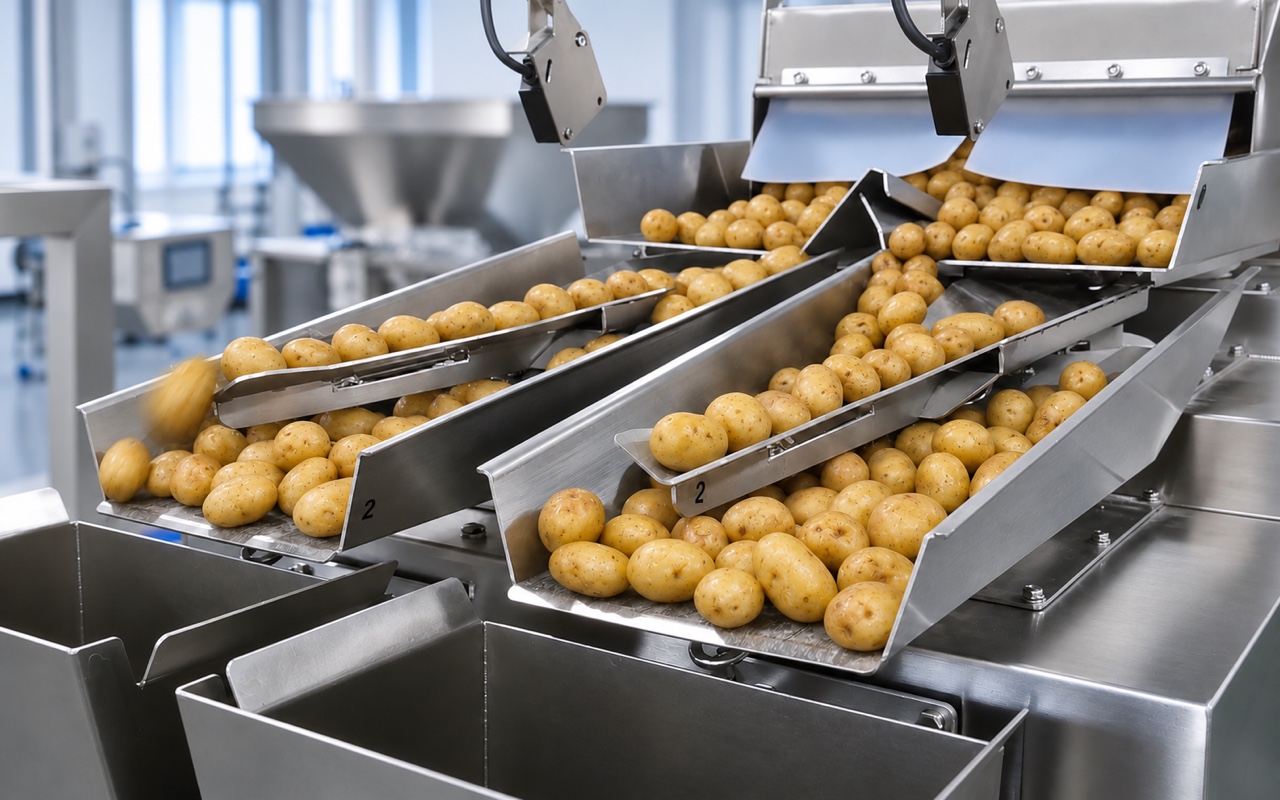
Look at one weighing head and count the vibrating trays that serve it. Some heads have a single tray, others have two. For suitably sized whole produce that tends to roll off a broad tray in groups, we would trial a head with three feed stages. All three serve the same weigh hopper.
- Bulk feed. The broad first tray moves enough produce to fill most of the portion quickly. Equipment suppliers also call this the coarse feed.
- Medium feed. A smaller second tray narrows the stream. Fewer pieces approach the drop together as the portion gets close to weight.
- Fine feed. A narrow rail sits above the feed path and catches a few pieces as the trays run. It moves them towards its tip, then holds them there. When the hopper is only a few pieces short, the rail vibrates gently to release the final pieces one at a time. You may see this finishing step called dribble feed in a machine specification.
Turning down the vibration on a single broad tray slows everything on it. Two small potatoes can still sit side by side at the lip and fall together. The narrow rail gives the last pieces a separate path. Choose the rail width for your crop. The largest pieces must travel freely and the smallest must still arrive singly. Even then, the weight of the last whole piece sets a limit on how close the fill can come to target.
When a quote says “three-stage feed”, ask the supplier: “Can you show me how the last piece enters the weigh hopper?”
What to watch in a packhouse trial
Run a representative sample, including the smallest and largest pieces you normally pack. Compare your current head with the proposed feeder at the same target weight and finished bags per hour. Watch whether pieces leave the fine rail singly or in pairs, whether the larger ones hang up, and whether operators have to intervene. Record average excess weight, light bags, rejects and damage. These are the figures you need to price the improvement.
Put a value on the improvement a trial demonstrates
Suppose a trial reduced excess from 8 g to 5 g at the same output and acceptable pack quality. Across 500,000 bags a year, the 3 g improvement would recover 1,500 kg. At an illustrative cost of 3 per kilogram, that is 4,500 in annual product value. Use your actual grade mix and packing season before making a budget decision.
For a simple payback estimate, subtract any extra annual operating costs from the verified annual saving. Divide the installed cost of the change by the resulting annual saving to get years to payback. If operating costs absorb the saving, product recovery alone won’t repay the investment.
Which weighing arrangement is worth trialling?
If individual pieces vary widely in weight, it can also be worth trialling a multihead weigher. It selects a combination of portions already weighed in different hoppers. Compare the giveaway and saleable bags per hour from each trial.
Continue your research
Published by Libratus Group on .
Your application
Discuss your project
Send us the size and weight range of your produce, the bag target, recent pack weights and the number of bags you need to finish per hour.